Why Parents Choose Chestnut Montessori School for Their Child’s Early Years
November 9, 2026

We know parents in Bellevue and the surrounding Eastside have many choices when it comes to their children’s early education. We also know these choices are not easy. There are many factors to weigh, but we hope this article will help you make an informed decision as you consider whether a classical Montessori environment is right for your family.


Montessori education has been successfully serving children and families around the world for over a century. The core principles remain—and for good reason. Our methods are consistently backed by current research in education and human development. As we move forward, we believe an authentic Montessori foundation gives children exactly what they need to thrive in a changing world.


1. Meeting Children Exactly Where They Are


Conventional education methods were originally developed to prepare large numbers of children for standardized instruction on an adult-prepared timeline. While many modern programs strive to differentiate, traditional structures can make personalized learning difficult to sustain.


Chestnut Montessori is specifically designed to allow each child to move at their own unique pace. We know that learning is not linear. Children who need extra repetition or hands-on practice receive warm, individualized guidance. Those who are ready to leap ahead find the academic challenges they crave. By guiding children individually or in small, focused groups rather than teaching a whole class the same skill at the same time, we honor each child’s natural developmental timeline.


2. Emphasizing the Whole Child (Social, Emotional, and Beyond)


Lots of schools use the phrase “teaching the whole child,” but in our classrooms, that commitment is lived every day. Academic growth shares equal importance with emotional regulation, social awareness, independence, and sensory development.


Movement, creative expression, and real-world practical life activities are integrated into our daily flow. In our small, cozy learning spaces, children actively practice grace and courtesy, learning how to navigate conflict with kindness and respect. Through our cosmic education and connection to our natural outdoor space, we help young learners see themselves as caring, capable members of a global community.


3. A Deep Academic Foundation Built Through Discovery


While our environment is warm and unhurried, Chestnut academics are exceptionally strong. It is inspiring to see four-year-olds blending sounds to read, five-year-olds exploring the decimal system with concrete beads, and six-year-olds classifying botanical specimens.


Because children engage with tactile Montessori materials, concepts become real before they become abstract. They discover answers for themselves rather than passively receiving information. We also capitalize on "sensitive periods"—windows of development where young children are naturally fascinated by specific skills. That is why a primary child in our program happily explores geometry concepts like rectangular prisms or triangle classifications years before they would typically encounter them in a standard curriculum!


4. A Small, Owner-Run Community Where Everyone Belongs


A school should be more than a building; it should feel like an extended family. Chestnut Montessori is intentionally small and owner-run, providing a calm, stable "home away from home" where every single child and family is known personally by name.


We actively cultivate this connection by:


  • Creating open, ongoing lines of communication between parents and teachers.
  • Hosting intimate parent education events to bridge classroom learning with life at home.
  • Gathering as a whole community for seasonal celebrations and casual weekend family outings.
  • Fostering gentle, multi-age social bonds where children learn from and care for one another.


5. Lifting Up Humanity Through Peace and Respect


From the very beginning, Dr. Maria Montessori saw education as a path toward a more peaceful world. We share that vision. By treating our youngest learners with profound respect, we help them develop a deep sense of dignity, empathy, and personal responsibility.


In our classrooms, peace begins with small daily choices—learning to use kind words, caring for our physical environment, tending to our garden, and appreciating the diverse cultures represented in our community. We strive to nurture confident, compassionate human beings who love learning and care deeply for the world around them.


We look forward to welcoming your family!


To continue the conversation or schedule a personal tour to observe our classrooms in action, reach out to our team today.

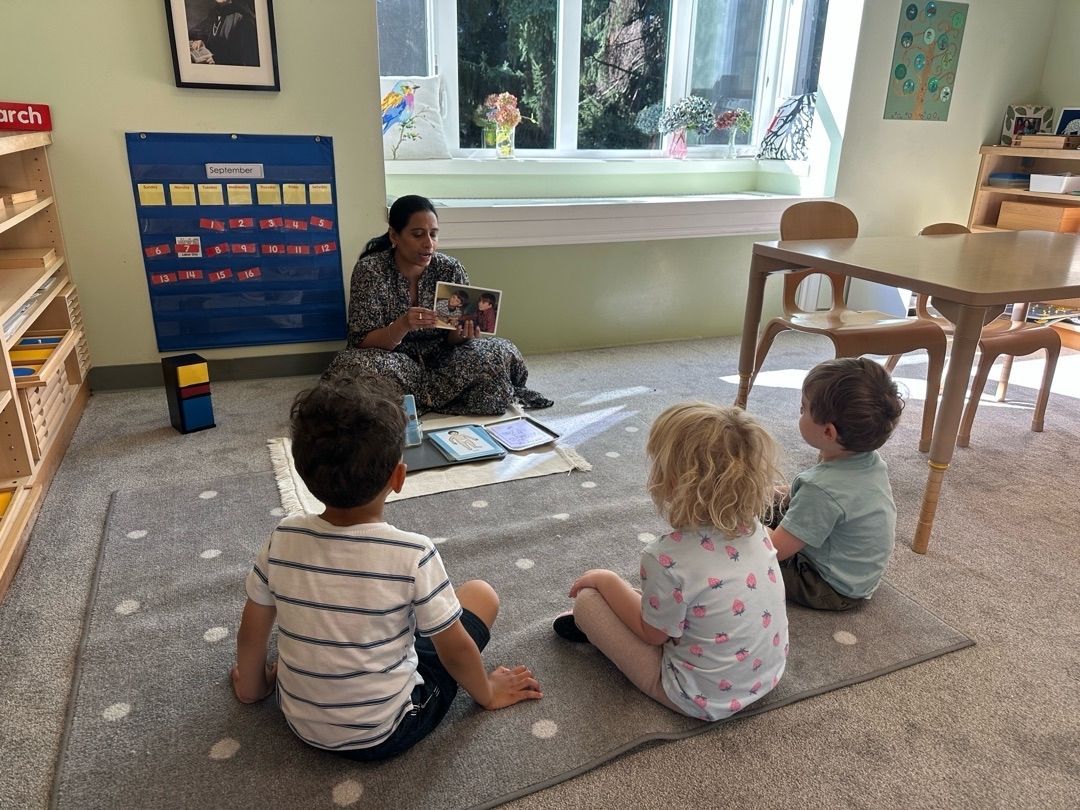
Three children sit on a colorful classroom rug, looking at a workbook and tray during a group activity.
November 2, 2026
Understanding the transitional child: Discover how Chestnut Montessori’s unique Kindergarten program bridges the First and Second Planes of Development through structure, abstraction, and curiosity.
montessori guide with children outside
October 27, 2025
What, exactly, is the role of the Montessori teacher? How is it so different from that of any other teacher? Sometimes it’s easiest to begin by explaining what a Montessori teacher isn’t. A Montessori teacher is less like the traditional idea of an instructor, and more like a gentle guide. They don’t consider it their job to give a child information. They rather lead children in the general direction and give them the tools they need to find the information themselves. Maria Montessori once said, “The greatest sign of success for a teacher...is to be able to say, ‘The children are now working as if I did not exist.’” Montessori Teachers Cultivate Independence In a Montessori classroom, rather than seeing a teacher at the front of the classroom giving the same lesson to every child, the teacher will be working quietly with individual children or small groups. While that is happening the rest of the children are free to spend their time doing the work that calls to them. A Montessori teacher works hard to create structures that allow children to be independent and to trust themselves as learners. One large part of what a Montessori teacher does is to intentionally prepare a classroom environment that is developmentally appropriate, is inviting to children, and supports them on their journey to work independently. This environment is constantly changing in tiny ways as the teacher notices new and evolving needs of the students. Montessori Teachers are Trained to Think Like Scientists Parents should know that Montessori teachers are highly trained. Most have recognized Montessori credentials in addition to their college degrees. Montessori certification programs are intensive and demanding; one might compare them as being the equivalent of another college degree. These training programs don’t just teach Montessori educators how to use the specialized materials; there is extensive coursework about Montessori philosophy, child development, and integrating the arts. When it comes to assessments, Montessori teachers don’t rely on standardized tests; they rely on the power of observation. They have notebooks brimming with evidence of what their students have mastered, need more support with, and are curious about. They are constantly recording what they notice children working on, how that work is being executed, and ideas they might have in anticipation of a child’s next steps. Montessori teachers literally sit beside a child and determine exactly what they know about a wide range of content areas. Montessori Teachers Think Long-Term Because of Montessori’s three-year cycles, teachers have the unique ability to consider their big picture when working with students. There is a natural tendency to allow the children to genuinely learn at their own pace. Getting to know a child and their family well over the course of a few years really supports this approach. Montessori Teachers are Often Called ‘Guides’ ...and for good reason. While children in Montessori classrooms have an abundance of choice in their educational pursuits, Montessori is based on the idea of ‘freedom within limits’. It’s the Montessori teacher’s job to carefully craft those limits. Children rely on having a certain amount of structure in place. This gives them comfort and a safe place in which they can take risks and try new things. Montessori teachers set some boundaries and then carefully help students navigate within them. What if your second grader loves to read but tends to avoid math? Their Montessori teacher will find ways to ensure the math still gets done. Sometimes this involves a gentle discussion with a child about time management skills, priorities, or setting goals. Sometimes the teacher will find a way to integrate the child’s interests into the less desirable work. Sometimes all it takes is a minor change in the environment. Montessori teachers gives children freedom, but they assist children in finding their way to success in this environment. Montessori teachers value independence, self-reliance, and intrinsic motivation. They also value cooperation, kindness, and strength in community. Still curious? Call us to set up an appointment today to observe in a classroom. See what Montessori is really all about.